
Reviewed · GHENT TOURS
Ghent Running and Sightseeing Tour
A Ghent sightseeing tour that starts with an easy run/jog is a fun twist on the usual “stand still and listen” morning. You meet outside the Ghent Opera House, get a brief warm-up, and then you slowly watch the city wake up while you cover more ground than a classic walking loop.
I like the way this route goes beyond the postcard center, with stops that connect places like Kouter and the Middle Age river trade of Korenlei and Graslei to how Ghent became Ghent. I also like the built-in photo breaks and the fact that the guide adjusts pace for the group. The main drawback to think about is that it is not suitable for everyone, including people with mobility impairments, back problems, pre existing medical conditions, and pregnant travelers.
Key things you’ll like on this Ghent morning jog
- Operas, squares, and towers on one simple loop: You start at Ghent Opera and end after landmark stops that make the city easy to remember.
- Leisurely pace, not a race: It’s meant to be accessible, with regular pauses for history and photos.
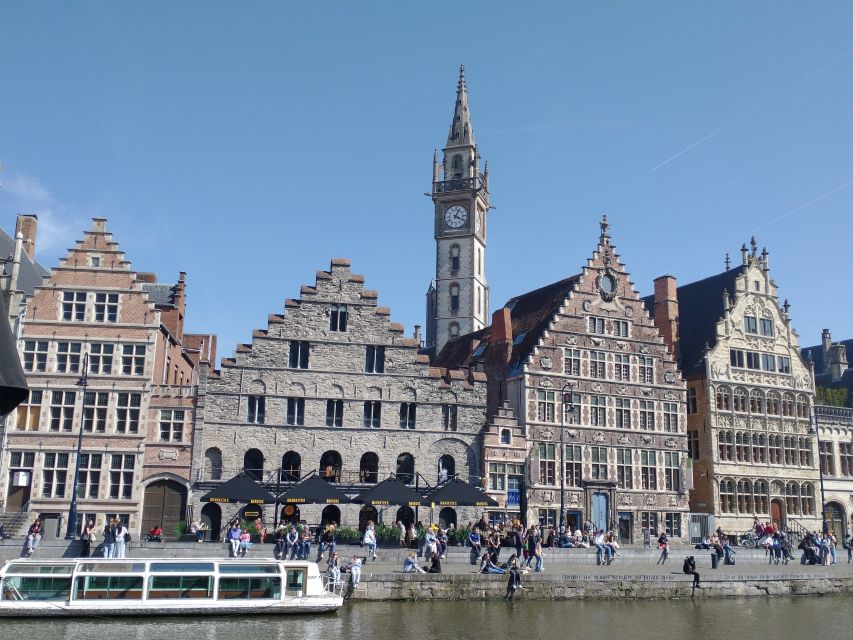
- Riverside stories that explain the city: Korenlei and Graslei, plus Portus Ganda, help you understand Ghent’s origins.
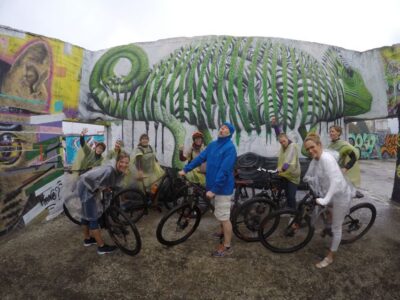
- Non-touristy feel: You run through a popular graffiti street and see quarters beyond the usual checklist.
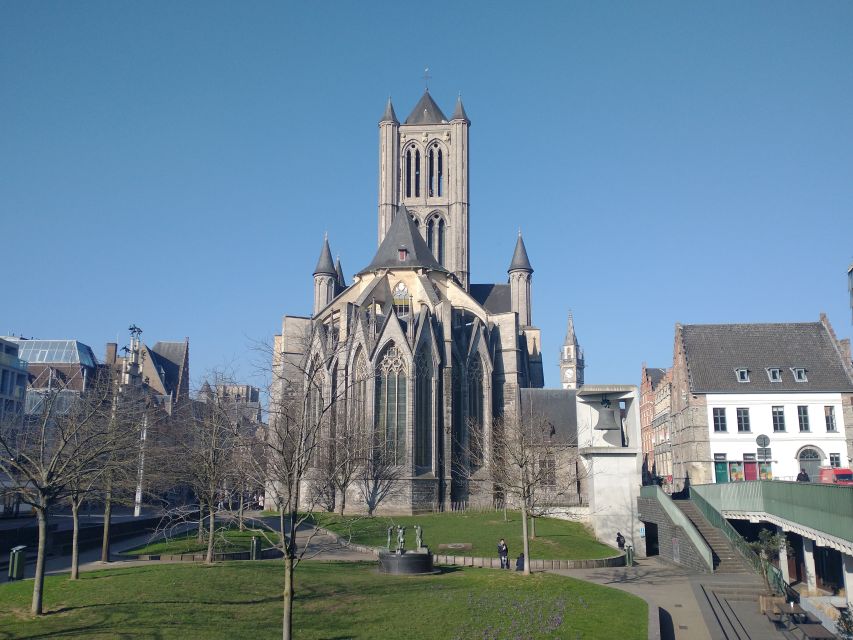
- Big landmarks plus side context: You hit St. Bavo Cathedral, the Ghent Belfry, and St. Nicholas Church, with explanations you can actually use.
- English guide, quick format: 45 minutes is short enough to fit before museums, yet long enough to get your bearings.
Why an easy run tour works so well for Ghent
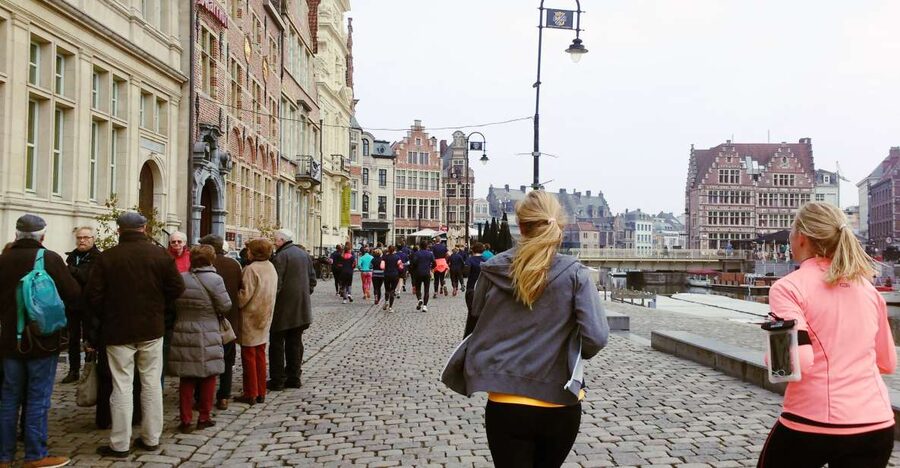
Ghent is one of those cities where the details matter. The problem is, if you only do a walking tour of the center, you can miss how different quarters connect. This run and sightseeing format fixes that. In just 45 minutes, you move between key spots while still stopping often enough to learn what you are looking at.
The “feel-good” idea here is simple: you start early, before the city settles into full tourist mode. You get a light workout, not an athletic test. And because you are traveling on foot anyway, the history lands in a way that feels more natural than reading signs while stuck in a slow crowd.
If you want a morning plan that gives you both movement and context, this tour is a strong candidate. You’ll also be better set up for the rest of your day, because you’ll understand the city’s shape, not just its highlights.
More days in Ghent:
- Ghent: 50-Minute Medieval Center Guided Boat Trip
★ 4.5 · 5,637 reviews - Historical Walking Tour: Legends of Gent
★ 5.0 · 1,761 reviews - Ghent: 40 Minute Medieval Center Guided Boat Tour
★ 4.4 · 884 reviews
Starting at Ghent Opera, then warming up in Kouter Square
The tour begins outside the main entrance of the Ghent Opera, near Kouter, a large square. Your guide welcomes you there and leads a brief warm-up, which is a small thing but a big deal. It helps you shift from travel mode into “let’s go” mode without feeling like you jumped into a random run.
Kouter matters because it is tied to the bigger story of how Ghent looked outward at key moments. The guide explains how Kouter relates to the World Expo. Even if you do not know anything about Expo history, this kind of framing helps you see the square as more than a backdrop for photos.
Right after the start, you also get the rhythm of the tour: run, pause, listen, and take a few pictures. That pattern matters for your energy level. You are not sprinting between stops. You are building a pace that works for your group.
Korenlei and Graslei: the Middle Age riverfront that shaped Ghent
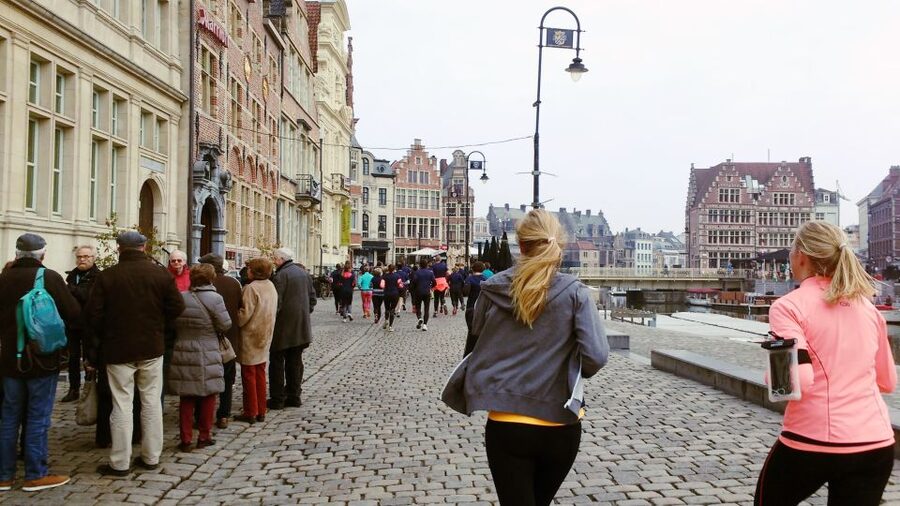
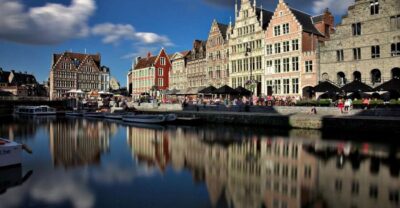
After Kouter, you head toward the riverfront areas that tell the Middle Age trading story. The guide points out Korenlei and Graslei, where the trade mattered during the Middle Ages. This is the kind of place where, once you understand what these banks were doing, the buildings and viewpoints make more sense.
Why this section is so useful: rivers are where cities grow, and Ghent’s river life helped define the city’s wealth and layout. When you learn what the trade looked like, you start noticing the logic of the streets around the water. You stop thinking of Ghent as “pretty buildings,” and you start seeing it as “a working city.”
You also get that satisfying morning feeling of moving along familiar-looking streets in a new way. You run through enough distance to feel like you are covering ground, but you stop enough that you actually remember what each location means.
Portus Ganda and the birth story behind the name
One of the most interesting shifts in this tour is how it connects the present-day city to its origin story. You learn about Portus Ganda and how it relates to the birth of Ghent. This is not just trivia. It is a reminder that Ghent began as a place shaped by waterways and commerce, not as a finished tourist map.
This kind of origin explanation helps later when you explore on your own. You’ll notice that many of the big viewpoints and route directions feel “natural,” like they were chosen because of water access and movement of people and goods. Even if you never take notes, the guide’s framing sticks.
Also, this is the part of the tour where you tend to slow down mentally. The jog keeps your body awake, while the story keeps your attention focused. It’s a nice balance for a short 45-minute outing.
Something different while you are in Ghent:
- Evening Tour of the Dark Side of Gent
★ 5.0 · 646 reviews - Ghent Bike Tour Off-the-beaten-track
★ 5.0 · 505 reviews - Ghent: 40-Minute Historical Boat Tour of City Center
★ 4.3 · 430 reviews - 40-Minute Guided boat trip in medieval Ghent
★ 4.0 · 368 reviews
Graffiti Street and the practical art of taking good city photos
After the more historical pieces, the route turns toward something modern and visual. You run through a popular graffiti street, with a stop for cool pictures. This stop is exactly why this kind of tour is worth doing early. You can grab photos without as many interruptions, and you are already in the right mindset for images.
Two practical tips for this section. First, wear sports shoes that you trust. If you’re fiddling with laces or stepping carefully on uneven spots, you lose the fun. Second, keep your phone or camera ready before the guide calls the photo stop. This tour builds photo moments into the route, but you still need to be quick and ready.
The bigger value is that you see Ghent as a living city. Yes, you hit major landmarks, but you also get the street-level texture that makes the place feel real.
Tower stops: St. Bavo Cathedral, the Ghent Belfry, and St. Nicholas Church
The tour includes stops at three of Ghent’s famous towers. You’ll see St. Bavo Cathedral, the Ghent Belfry, and St. Nicholas Church. This is a smart move because towers act like anchors. If you understand where these towers are and what they represent, the rest of your exploration gets easier.
Here is what makes these tower stops effective on a short tour. You are not just looking at impressive buildings, you are learning how they connect to the city’s identity. The guide also explains different quarters and how the city’s landmarks relate to each other.
A heads up for your expectations. You likely will not get a long, sit-down history lesson inside each site on a run tour format. Instead, you get the key storyline and enough pointing and context so that, later, you know what you are looking for. If you want extra time at one tower, you can build it into your own schedule after you’ve done this quick orientation.
Opera and Handelsbeurs: why those buildings matter in Ghent
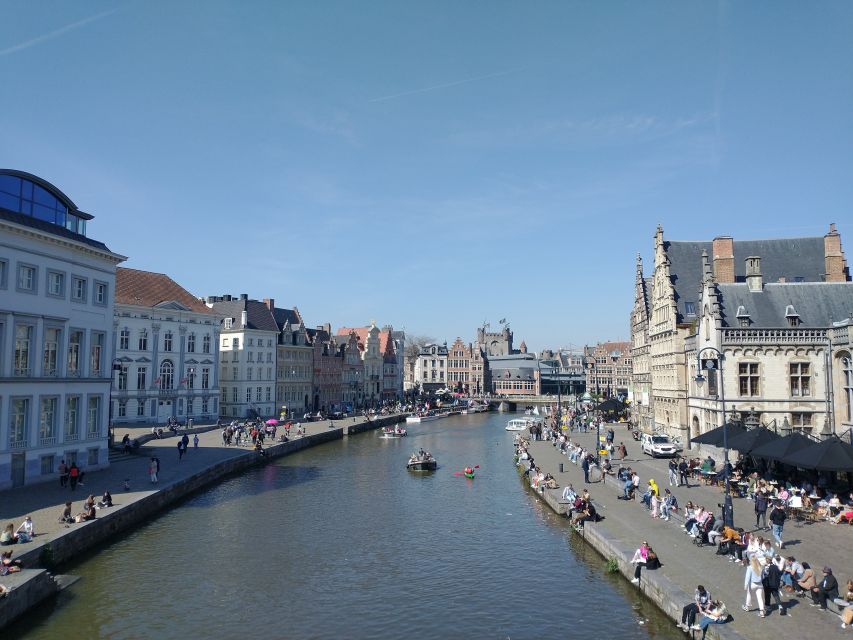
Another standout part of the tour is how it broadens the story beyond medieval trade. The guide talks about the importance of the Opera and the Handelsbeurs. This is where Ghent stops feeling like only old stone and starts feeling like a city with continuous cultural and economic roles.
Why you should care about this section: it gives you a framework for interpreting what you see afterward. If you wander past the opera district later, or you notice a historic-looking building that you cannot quite place, you’ll have a mental handle. That makes your self-guided time better.
It also keeps the tour from being one-note. You go from origins and trade, to street life and modern visuals, then back to big civic buildings with meaning. That variety helps you stay engaged, especially because the total duration is only 45 minutes.
Pace, distance, and what 45 minutes really feels like
The biggest promise here is that it is a leisurely run/jog. It is not a competition. The guide adjusts pace to match the group, and you make regular stops at landmarks for history and photos. That means you are not racing ahead while the rest of the group catches up.
In terms of distance, one experience described covering about 6 km at an easy tempo. Even if your pace ends up a bit different, that ballpark gives you an idea: this is enough to feel like you did something, not so much that you get wiped out.
What to wear is straightforward. Bring sports shoes and sportswear. You’ll want clothing that lets you move comfortably for short bursts of running plus standing still for explanations and photos.
One small but important note for timing: because you make stops, you should treat the tour as a whole 45-minute block, not “45 minutes minus breaks.” If you are trying to catch a museum timed entry right after, give yourself a buffer.
Price and value: is $53 worth a 45-minute tour?
At about $53 per person for 45 minutes, you are paying for three things at once: a local English guide, movement that covers more ground than a typical walk, and history delivered at each stop. You are also paying for photo opportunities and discovery of non-touristy spots, not just the famous tower trio.
Is it expensive? It might feel like it until you compare it to what else you would do in 45 minutes. A classic self-guided loop is free, but you would miss the connections, like how Kouter ties to the World Expo, why the Middle Age riverfront mattered, and what Portus Ganda adds to the origin story.
This tour is also capped by format. You get enough structure to feel “oriented,” but not so much time commitment that it hijacks your day. If you plan your trip around a few key paid activities, this is the kind of cost that can pay off because it helps you explore the rest of Ghent smarter.
A practical value tip: bring your own water since it is not included, and consider a small snack if you know you get hungry early. You do not need to turn this into a long workout, but hydration keeps the experience comfortable.
Who should book, and who should skip this easy run tour
This tour suits people who want a morning plan that combines light exercise with city learning. It is ideal if you like walking tours, but you get restless when everything is slow and static. It also works well if you want a first-time Ghent orientation, because the landmarks and riverfront stops teach you the city’s logic quickly.
I would also recommend it if you enjoy photography and like the idea of planned photo moments rather than trying to guess where the best shots are.
On the other hand, skip it if any of the listed restrictions apply. It is not suitable for pregnant women, people with back problems, people with mobility impairments, children under 18, or people with pre-existing medical conditions. If you have doubts, you should treat those limits as a sign to choose a different tour format that is easier on your body.
One more practical note: audio recording is not allowed, and smoking is not allowed. If you were planning to record narration for later, plan to rely on your memory and the guide’s live explanations.
How to show up without stress (and keep your morning smooth)
Bring your passport or ID card. In Belgium it is mandatory to have ID on you at all times, even if you do not need to show it to the organizer. That one detail can save you from an awkward moment when you’re out and about.
Use sports shoes, and wear sportswear that you can move in. If you come in wearing fashion sneakers that you only wear occasionally, do not do it. You will want grip and comfort for the short running portions and standing stops.
For logistics, you’ll meet outside the Ghent Opera main entrance near Kouter. That start point is easy to find once you’re oriented around the square.
Should you book the Ghent Running and Sightseeing Tour?
Book it if you want a smart first look at Ghent that mixes easy movement with clear storytelling. This is especially good if you like the idea of seeing major towers, plus the riverfront trade background and a little street color like the graffiti area, all in a short window.
Skip it if you need a fully seated, low-impact experience, or if you fall into the tour’s listed non-suitability categories. The format depends on being able to jog, even at a relaxed pace, and it includes regular landmark stops.
If you are the type of traveler who thinks mornings are for orientation, this tour fits your style. You’ll come away with a better map in your head, and you’ll have already learned why the city looks the way it does, from Kouter to the towers.
FAQ
Where do I meet for the Ghent Running and Sightseeing Tour?
You meet outside the main entrance of the Ghent Opera, near Kouter.
How long is the tour?
The tour lasts 45 minutes.
Is this tour a race or competition?
No. It is a leisurely run/jog, and the guide adjusts the pace to match the group.
What fitness level do I need?
It is designed to be accessible because it is not competitive. Still, you should be comfortable running or jogging lightly for the duration, plus stops for sightseeing.
What should I wear and bring?
Wear sports shoes and sportswear. Bring your passport or ID card.
Is ID required even if I do not show it to the organizer?
Yes. In Belgium, ID must be carried with you at all times.
Is water included?
No. A bottle of water is not included, though it is recommended.
What is not allowed during the tour?
Smoking is not allowed, and audio recording is not allowed.
Who is this tour not suitable for?
It is not suitable for pregnant women, people with back problems, people with mobility impairments, children under 18, or people with pre-existing medical conditions.
What language is the guide in?
The tour guide speaks English.
Reviewed lately in Ghent
- Children’s escape game in the city of Ghent Marsupilami★ 5.0 · 3 reviews
- Ghent Walking Tour – City Highlights and Beyond Tradition★ 4.5 · 3 reviews
- Ghent Scavenger Hunt and Highlights Self Guided Audio Tour★ 3.5 · 3 reviews
- Discover Ghent while playing! Escape game – The alchemist★ 4.0 · 4 reviews
- e-Scavenger hunt Mons: Explore the city at your own pace★ 5.0 · 4 reviews
- Discover Ghent while playing! Escape game – The Walter case★ 4.5 · 4 reviews
- Discover Mons while playing! Escape game – The alchemist★ 4.0 · 5 reviews
- Ghent Brewery Visit and Beer Tasting Tour with Chocolate Pairing★ 5.0 · 6 reviews
Ghent Tours, compared.
Ghent: 50-Minute Medieval Center Guided Boat Trip
Read our review →
Ghent: 40 Minute Medieval Center Guided Boat Tour
Read our review →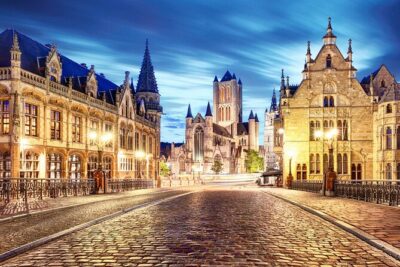
Ghent: 40-Minute Historical Boat Tour of City Center
Read our review →
Browse the lists this tour appears in