
Reviewed · SCAVENGER HUNTS
e-Scavenger hunt Ghent: Explore the city at your own pace
Ghent is a city that begs for wandering, and this e-Scavenger Hunt turns that free-roam feeling into something more focused. You’ll cover a chunk of the historic center, and the game format helps you notice details you might otherwise gloss over. I like that it’s self-guided at your pace, and I also like that it uses a smartphone app to keep the walk fun and family-friendly.
One thing to consider: you’ll need your own smartphone, plus you should plan for data on the street, since the tour does not include a phone or data. If you expect a guided, step-by-step group with a human host, this is a different style, more choose-your-own-moments than lecture.
Key things to know before you start
- A team setup (up to 6) makes it feel like a shared game, not a crowded group tour
- Free app turns sightseeing into clue-finding on your phone
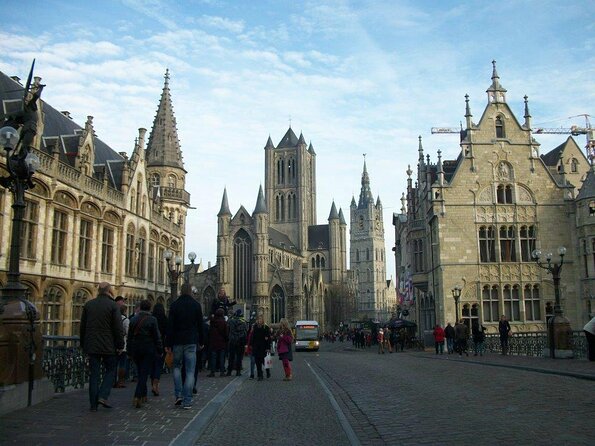
- Big-name landmarks are all within walking reach, including the Town Hall, St. Bavo, and Gravensteen
- Riverfront stops along the Leie add classic Ghent views, boats, and terrace vibes
- Pastel streets and photo stops like Patershol and the graffiti street keep the route from feeling repetitive
A self-guided city game that actually helps you see Ghent

This is a city trail built for wandering. The goal is not just to reach famous places, it’s to move through them with prompts that nudge you to look closer. That matters in Ghent because the best stuff is often in plain sight: a square’s proportions, a façade’s story, or the way the river cuts the center into sections.
You start at Sint-Baafsplein, and you finish back at the same meeting point. The route is designed for about 2 to 4 hours, which is long enough to feel like you did something meaningful, but short enough that you can still pivot afterward to a museum, lunch, or a second walk.
Because it’s private (only your group), you’re not stuck matching a stranger’s speed. If your group has kids, the game format tends to keep energy up. If you’re traveling solo or as a couple, it still works well, since you can pause when you want, and take detours without asking permission.
More City Tours in Ghent
- Ghent: 40-Minute Historical Boat Tour of City Center
★ 4.3 · 430 reviews - Ghent: Guided City Tour with Food Tastings
★ 4.8 · 228 reviews - Ghent: City Highlights and Hidden Gems Guided Bike Tour
★ 4.7 · 196 reviews
Price and value: $37.24 per group is about route coverage, not tickets
The price is $37.24 per group for up to 6 people. That pricing is usually a good deal when you treat it as a way to “pay for planning” rather than paying for admissions. You’re essentially buying a route, an interactive way to follow it, and a smartphone app.
A practical note: smartphone and data are not included. So the true cost depends on your phone plan and how you handle connectivity. If you rely on mobile data for the app to function smoothly, check your roaming plan or grab a local SIM. If the app works offline once loaded, you’ll be fine. Either way, bring a charged battery.
Also, the tour is offered in English, and it’s described as user-friendly for hearing impaired. Service animals are allowed, and it’s near public transportation, so you’re not marrying yourself to a car.
How the smartphone hunt works in real life
You’ll get a mobile ticket, then you’ll use the tour’s app on your phone during the game. The app turns the walking route into a sequence of tasks tied to places you pass, which is what makes the experience feel like more than a normal walk.
Here’s how to make it smooth:
- Bring fully charged phone (and consider a small power bank)
- If you’re traveling with kids, decide early how you want to run the team (one person reads clues, another person checks answers)
- Take advantage of the fact it’s at your own pace. Slow down at the spots that grab you, and breeze through the ones you don’t care about
If you’re hearing impaired, it’s built to be user-friendly, but I can’t promise what kind of captions or visual instructions you’ll see without checking the app itself. Still, the overall format is phone-based, which often helps when you can follow on-screen prompts at your speed.
Stop 1: Sint-Baafsplein to Vrijdagmarkt, the old square that sets the tone

You begin on Sint-Baafsplein, and from there the trail heads toward Vrijdagmarkt. This square is one of Ghent’s oldest. The interesting detail here is scale: it’s about one hectare, which tells you why this place still feels important even after centuries. Big old squares are where cities show off their identity, and Vrijdagmarkt is exactly that kind of space.
When you’re walking clue-to-clue, pay attention to how the buildings frame the square. In Ghent, the stonework and street widths do a lot of storytelling, and these older open spaces help you orient yourself mentally before you start climbing into the more “wow” architecture.
Tip: give yourself a minute to just stand and look around. This is one of those moments where a scavenger hunt format pays off, because the clues will likely pull you to something specific, and you’ll understand the setting faster.
More Scavenger Hunts in Ghent:
- e-Scavenger hunt Kortrijk: Explore the city at your own pace
★ 4.5 · 15 reviews - e-Scavenger hunt Ostend: Explore the city at your own pace
★ 4.5 · 10 reviews - e-Scavenger hunt Mons: Explore the city at your own pace
★ 5.0 · 4 reviews - Ghent Scavenger Hunt and Highlights Self Guided Audio Tour
★ 3.5 · 3 reviews
Town Hall area: a four-sided complex you can spot from multiple angles

Next up is Ghent’s Town Hall, described as a four-sided complex of buildings surrounded by the Botermarkt, the Hoogpoort, the Stadhuissteeg, and the Poeljemarkt.
That “four-sided” detail is useful because it changes how you view the stop. Instead of treating the Town Hall like one flat façade, think of it as a cluster that you can approach from different streets. As the route guides you, you’ll likely get more than one viewing angle, and that helps you read the architecture.
Practical mindset: don’t try to capture everything in a single shot. Let the building “come to you” from street corners as you continue the walk. In a normal tour, you might do one photo and move on. With a clue hunt, you naturally spend a little more time near the important edges and doorways.
Saint Bavo’s Cathedral: oldest parish roots and a real character named Gheeraert Vilain

Then the route reaches Saint Bavo’s Cathedral, described as the oldest parish church in Ghent’s lively heart. The cathedral site goes back to a 10th-century church, and there was also a Romanesque church before the later structure you see.
One of the most memorable historical notes attached to this stop is Gheeraert Vilain, a builder knight nicknamed the Devil. The information you get here matters because it turns the cathedral from “big church, pretty stone” into a story about people and power. Even better, the cathedral’s associated building connection was sold to the city of Ghent around 1328, which anchors the legend in actual civic history.
What to do on the ground: take your time at the transition points where you move from streets into the church area. Cathedral precincts often change the sound level and the way light hits the stone. That’s the kind of sensory shift you notice more when you’re not rushing with a group.
Gravensteen: the medieval castle in Flanders with defense systems still intact
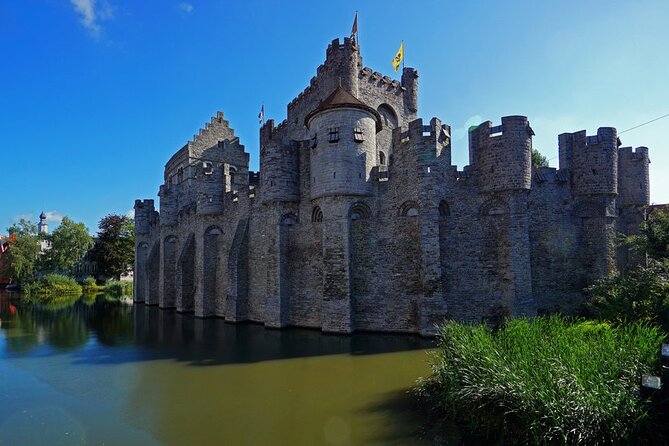
Next comes Gravensteen, Ghent’s only remaining medieval castle in Flanders. The key detail is that it has an almost intact defense system, which makes it more than a romantic photo spot. Even if you only look from the outside while doing the clue tasks, it’s worth understanding that you’re looking at a structure that was built to withstand attack.
Also, castles in cities like Ghent work differently than castles on hills. Here, the castle is part of the urban fabric, so you get that “medieval fort inside modern streets” feeling. That contrast is part of why the walk works.
If you love medieval architecture, this stop usually becomes a favorite because it gives you “context weight.” After you see it, the Town Hall and the church feel like the civic and religious sides of the same power world.
Ghent city center around Korenmarkt and the river Leie: where everything clicks

The heart of the trail is centered in Ghent city center, with the area around Korenmarkt and the river Leie. The walk is essentially built around the medieval core. This matters because you’re not bouncing randomly around town. You’re staying where the city’s identity is densest.
From a value standpoint, that’s smart. You get the biggest sightseeing payback by clustering the time. You’ll also find this is a natural place to reset your energy for the next segment, because the river walk and nearby streets provide lots of easy pauses.
Graslei and Korenlei: terraces, boats, and the classic Leie postcard view
One of the most enjoyable parts is the stretch along Gentse Graslei and Korenlei. This segment is framed as relaxing, with historic buildings, terraces, water views, and boats.
This is where the clue format helps you enjoy the scenery more, not less. Instead of just walking while you think about your next meal, you’ll likely have prompts that get you to look at the waterfront structure and the way the buildings face the river.
Practical photo advice: take a few shots that include people and boats, then a few that include just the buildings and water line. The first type feels alive, the second type is more architectural.
St-Michael’s Bridge and St-Michael’s Church area: quick views toward the center
The route also includes St-Michael’s Bridge, situated on the river Leie, near St-Michael’s Church, and looking toward the city center.
This stop is a good break point because bridges naturally “compress” a view. You get a sense of direction and depth. If your legs start feeling heavy, use the bridge area to reset. It’s also a decent place for a snack stop, depending on where your clue tasks pull you next.
Belfry of Ghent: the 95-meter tower in the famous tower row
Next is the Belfry of Ghent, described as a 95-meter high tower in the center of the city. It’s also noted as the middle tower of the famous Ghent tower row. That detail is worth keeping in mind because it makes the tower more than a random landmark.
A tower row is about rhythm, and it’s easier to understand the city when you notice how multiple towers line up. As you walk, try to spot it from more than one street. The clue route usually encourages this kind of attention, which is one reason a scavenger hunt can outperform a standard “see the big sights” plan.
Merchant and guild church plus the grain trading square: the business side of medieval Ghent
The trail includes a church that dates back to the 11th century, and it’s described as the church of the wealthy merchants and of the guilds of Ghent. Alongside that, you’ll also hit a square that served as the place where grain was traded starting in the 10th to 11th century, with grain arriving via the Leie or Scheldt.
Even if these sound like “history facts,” they’re actually useful for understanding why Ghent looks the way it does. Medieval cities were not just about churches and kings. They were about trade, guild control, and storage and movement of goods. The river economy shaped everything.
So when your clue tasks bring you into these spaces, try to connect the dots:
- The river enabled trade
- The guilds controlled livelihoods
- The buildings you see were civic signals, not just background decoration
Patershol: narrow medieval streets, cafés, and a slower pace
Then you get to Patershol, described as an old neighborhood in Ghent’s historic center. It’s known for narrow medieval streets plus plenty of cafés and restaurants.
This is one of those route sections where you’ll feel the city switch modes from “landmark sightseeing” to “living neighborhood.” If you want to feel like you’re in Ghent rather than just passing through it, this is where you do it.
I suggest you don’t treat Patershol as a quick checkbox. If your clue tasks allow time, drift down a couple side streets, then come back. That small detour is often the difference between seeing Ghent and feeling like you know it.
Ghent Museum of Fine Arts: an optional-thinking stop, even if you only glance
The trail touches the Ghent Museum of Fine Arts, described as one of the oldest museums in Belgium. Its collection includes paintings, sculptures, drawings, etchings, and tapestries.
One key reality: the tour format is built for walking and clue tasks, so you might not spend full museum time. That’s not a problem. Even a short stop here can help you decide if you want to come back later for a longer visit.
If art is a priority for you, use this part of the walk as your planning cue. Note what you’re most curious about, then pick your timing. If art is not your priority, you can treat it as a quick pause and keep going.
Graffiti street: the Hoogpoort to Donkerstraat alley that earns its nickname
Finally, there’s the winding alley between the Hoogpoort and the Donkerstraat, also called the graffiti street because of its appearance.
This stop works because it adds contrast. After stone monuments and formal civic spaces, a small alley with street art vibe feels fresh and modern. It’s also a great example of how scavenger hunt routes keep you walking through different “textures” of a city, not just repeating the same type of scene.
If your phone battery is low, this kind of stop is nice because it’s easy to capture what you need quickly while staying part of the game.
Logistics that affect your day: timing, starting point, and finishing back at Sint-Baafsplein
The tour runs roughly 2 to 4 hours, and it’s available daily within the listed opening window. Because your start and end are the same, you can plan your meal and rest stops with less stress.
The route passes major center sights. That’s a plus, but it also means you’ll be walking in the busiest tourist area at a normal daytime pace. Wear comfortable shoes, and keep your phone ready at clue moments so you’re not fumbling in the street.
Also, you’re working as a group of up to 6 people. That team size matters. It’s big enough for shared laughs and collaboration, but small enough that the group doesn’t fracture into separate interests. If you have a larger party, you might need to organize teams.
Who this e-Scavenger Hunt fits best
This works really well for:
- Families who want a city walk that feels like a game
- Couples who like structure but still want freedom
- Small groups of friends (up to 6) who prefer doing their own thing
It might not be ideal if you want:
- A traditional guided tour with lots of spoken explanations
- A pace that’s strictly guided, turn-by-turn by a person
- No phone use at all
The interaction is the point. And the route choices keep you seeing the big Ghent classics, but in a way that feels active instead of passive.
Should you book this Ghent e-Scavenger hunt?
I’d book it if you want a fun, flexible way to cover Ghent’s most important sights without feeling locked into a rigid schedule. The best part is the format: clue-based walking plus practical tips helps you notice more as you move through the city. With a high overall rating of 4.3 from 41 reviews, the concept clearly lands for a lot of people.
Skip it only if you strongly dislike phone-based self-guided travel, or if you don’t want to manage data and battery. If you’re ready for a city game with landmark rewards, this is a smart-value way to spend a half-day in Ghent.
FAQ
How long does the Ghent e-Scavenger hunt take?
It takes about 2 to 4 hours.
Where does the tour start?
The meeting point is Sint-Baafsplein, 9000 Gent, Belgium.
Is it a guided tour with a host?
It’s a self-guided experience using a smartphone app for the game.
What language is the app offered in?
The experience is offered in English.
Do I need to bring a smartphone?
Yes. The tour provides a mobile ticket and a free app, but smartphone and data are not included.
Can I cancel for free?
Yes. You can cancel up to 24 hours in advance for a full refund.
Reviewed lately in Ghent
- Ghent Running and Sightseeing Tour★ 5.0 · 3 reviews
- Children’s escape game in the city of Ghent Marsupilami★ 5.0 · 3 reviews
- Ghent Walking Tour – City Highlights and Beyond Tradition★ 4.5 · 3 reviews
- Ghent Scavenger Hunt and Highlights Self Guided Audio Tour★ 3.5 · 3 reviews
- Discover Ghent while playing! Escape game – The alchemist★ 4.0 · 4 reviews
- e-Scavenger hunt Mons: Explore the city at your own pace★ 5.0 · 4 reviews
- Discover Ghent while playing! Escape game – The Walter case★ 4.5 · 4 reviews
- Discover Mons while playing! Escape game – The alchemist★ 4.0 · 5 reviews
Scavenger Hunts, compared.

e-Scavenger hunt Antwerp: Explore the city at your own pace
Read our review →
e-Scavenger hunt Bruges: Explore the city at your own pace
Read our review →
Bruges Scavenger Hunt and Highlights Self Guided Audio Tour
Read our review →
Beer Tasting and Scavenger Hunt in Brussels – About 3 Hours
Read our review →
e-Scavenger hunt Mechelen: Explore the city at your own pace
Read our review →
e-Scavenger hunt Hasselt: Explore the city at your own pace
Read our review →
e-Scavenger hunt Brussels: Explore the city at your own pace
Read our review →
e-Scavenger hunt Leuven: Explore the city at your own pace
Read our review →Browse the lists this tour appears in