
Reviewed · SCAVENGER HUNTS
e-Scavenger hunt Kortrijk: Explore the city at your own pace
This is one of those rare city activities that turns sightseeing into a game, without locking you into a fixed schedule. You follow a smartphone trail and answer questions at standout spots, like the UNESCO Beguinage and St. Martin’s Church area, while you decide how slow or fast to go. I love the mix of interactive city highlights with slower, less obvious corners, and I also like that you can pause, reorder, and take breaks. One thing to consider: you’re relying on your own smartphone and data for the app, and if location tools are cranky you may need to use regular maps to keep scoring moving.
I also like the way the route nudges you into different eras of Kortrijk. You’re not only chasing pretty facades, you’re learning why limestone towers, Flemish-count statues, linen production, and battle memorials mattered. It’s an easy-win activity when you want structure but not a lecture.
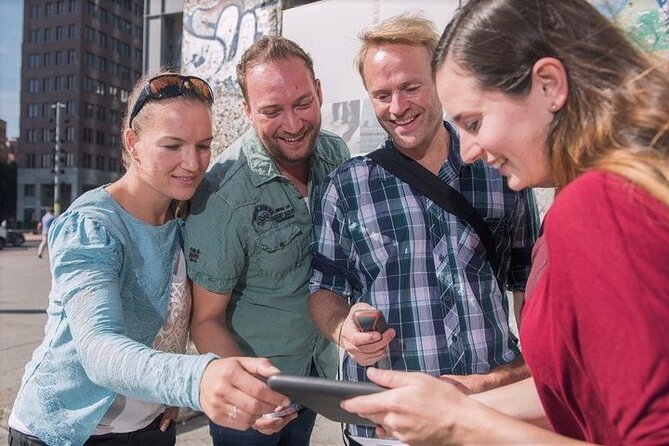
If you’re traveling in a group, the format fits well. It’s private for your group (up to 6), it’s offered in English, and it runs on an online app with a mobile ticket. If you hate fumbling with tech, do a quick test before you start so you’re not solving the game and your navigation at the same time.
Key things that make this Kortrijk hunt worth your time
- UNESCO Beguinage storytelling, from 13th-century origins to 17th-century cottages
- A history-and-design route, including limestone towers like the Speytorre and church sites dating back to early worship
- Linen and Lys Valley context at Texture, which connects industry to the landscape
- Battle of the Golden Spurs landmarks, through Groeningepoort, Groeninge Gate, and Groeninge monument
- Fun pacing for families and mixed ages, because many questions work for kids too
- Group-friendly format, private for up to 6 people so nobody gets left behind
The game plan: how you explore Kortrijk at your own pace
This is a self-guided city trail built around a phone game. You start at Stationsplein 6 in Kortrijk, and the activity ends back at the same meeting point. The walk typically takes about 2 to 4 hours depending on how long you linger at each stop and how often you pause to compare answers.
The practical upside is simple: you’re not waiting for a guide, and you’re not stuck with a single pace. You can go at walking speed, stop for photos, or take a break before you move on. The practical downside is also simple: you need your phone ready, plus data, because the app does the work.
For best results, I’d plan to travel with a fully charged phone. If the GPS part of your experience is slow or fails on you, stay calm and use Google Maps or another map app to get to each location. You’ll still enjoy the route, even if scoring mechanics feel slightly fussier when the location tool is laggy.
More City Tours in Ghent
- Ghent: 40-Minute Historical Boat Tour of City Center
★ 4.3 · 430 reviews - Ghent: Guided City Tour with Food Tastings
★ 4.8 · 228 reviews - Ghent: City Highlights and Hidden Gems Guided Bike Tour
★ 4.7 · 196 reviews
Start at Stationsplein 6, then aim for the Beguinage core
You begin at Stationsplein 6, which is convenient because it puts you on a walkable loop through central Kortrijk rather than sending you far out right away. From there, the route swings toward the city’s most famous quiet pocket, the Beguinage.
The Beguinage has UNESCO World Heritage status and dates back to the 13th century. What makes it worth slowing down for is that you’re not just looking at one building, you’re moving through a whole way of life: small houses, courtyards, and places to sit for a minute and actually notice details.
The route also connects the Beguinage to conflict and rebuilding. You’ll see the idea that it was destroyed multiple times in major turning points, including 1302 during the Battle of the Golden Spurs, 1382 after the Battle of Westrozebeke, and again by the French in 1684. Then you get the longer view, where the 41 cottages you see date to the 17th century. That blend of calm scenery and hard history is why this part of Kortrijk hits.
Quick tip
Wear shoes you’re comfortable walking in. The best parts here are the courtyards and the short stroll sections, not just the photo spots.
Speytorre and Texture: why limestone, towers, and linen matter

From the Beguinage zone, the trail pushes you toward the Lys Valley story, and that’s where Kortrijk becomes more than just pretty streets.
One stop focuses on towers built from limestone and sandstone. The southern Speytorre was built in 1385 to control traffic on the Lys. Even if you don’t become a medieval traffic-nerd, it’s a useful way to see how rivers, trade, and power shaped where people lived and moved.
Right after that, the route connects the region’s economy to its cloth. Texture is the museum stop that explains how flax cultivation and processing led to linen fabric, tied directly to the development of the Lys Valley around Kortrijk. If you usually skip museums because you think you know the topic, this is the one that can surprise you because the story is local and practical, not abstract.
If you have limited time, you still benefit from the stop because it reframes what you’re looking at across the city. You start to notice how a city can be “about” textiles even when it looks like stone and brick.
More Scavenger Hunts in Ghent:
- e-Scavenger hunt Ghent: Explore the city at your own pace
★ 4.5 · 41 reviews - e-Scavenger hunt Ostend: Explore the city at your own pace
★ 4.5 · 10 reviews - e-Scavenger hunt Mons: Explore the city at your own pace
★ 5.0 · 4 reviews - Ghent Scavenger Hunt and Highlights Self Guided Audio Tour
★ 3.5 · 3 reviews
Church of Our Lady and early worship sites
Next, the route turns more spiritual and architectural. The Church of Our Lady is connected to Count Baldwin IX, with construction started in 1199. The key idea here is its setting, because it was located within the grave domain of Kortrijk, so the church and burial life were intertwined.
Then you get an extra layer of time depth through St. Martin’s Church. The site was already home to a place of worship around 650 AD. That means you’re not just seeing a building, you’re standing on an area that has been important for a very long time.
This is a good section for photo lovers, but it’s also a good “slow down” area. When a route spends time on continuity like this, the questions feel more grounded, and your walk starts to feel like a guided story even though you’re doing it yourself.
Groeninge Abbey and Kortrijk 1302: the Battle of the Golden Spurs, explained
One of the most interesting museum stops along the trail is Kortrijk 1302, described as a multimedia museum located in the Beguinage Park. The topic centers on myth-making around the Battle of the Golden Spurs.
Even if you don’t go deep into every media element, the stop makes the surrounding memorials easier to understand later. You get the idea that history is not only dates and names, it’s also how stories get shaped and repeated. That makes Groeningepoort and the nearby commemoration points feel less random when you reach them.
Right nearby, the trail also takes you through architecture and symbolism, including a stop that points out a Gothic-Renaissance transitional style and a façade filled with statues of the counts of Flanders. The practical value of this is that you start training your eyes. Facades become readable instead of just decorative.
The rose garden and the castle grounds you can actually enjoy
The trail includes the International Rose Garden, dating back to 1959, located in the gardens of the castle ’t Hooghe. This is a nice break from the heavier history blocks because it gives you something straightforward: space, color, and a place to reset.
If your group includes people who need regular breaks, this stop helps a lot. You get a chance to stop walking, check your phone without rushing, and come back to the route refreshed. It’s also an easy one for families because it’s not intimidating or overly technical.
Shopping centers as part of the city map
The route doesn’t only stick to monuments. It includes stops for major shopping areas in Kortrijk, including K in Kortrijk and Ring Shopping.
K in Kortrijk is described as being in the heart of Kortrijk with more than 80 shops and restaurants across 34,000 m2. Ring Shopping is an indoor center on the outskirts with no less than 90 shops.
Why include shopping centers on a history-oriented trail? Because it can solve real traveler problems. It gives you sheltered points to regroup, recharge, and handle phone use without everyone getting frustrated in bad weather. It also helps you see how Kortrijk functions day-to-day, not only how it looked centuries ago.
If you’re not interested in shopping, you can treat these stops as waypoints. Focus on any required question tasks, then move on.
Baggaertshof and the Beguinage legacy of care
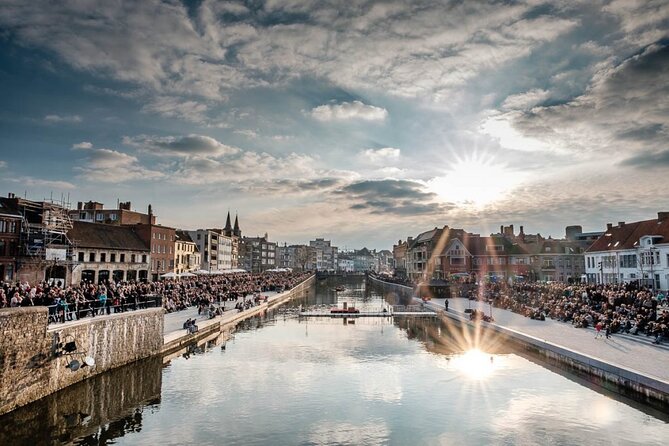
Another stop highlights the Baggaertshof, founded in 1638 by Joossine Baggaert, who set up 13 cottages for needy women. This is one of those details that makes a city’s monuments feel human.
You’re not just looking at stone. You’re seeing how communities built support systems and made them part of the urban fabric. For me, this kind of stop is a reminder that architecture often reflects social needs.
When it’s paired with the wider Beguinage context and its long story of destruction and rebuilding, the whole area feels more complete.
Grote Markt, belfry, and cloth hall beginnings
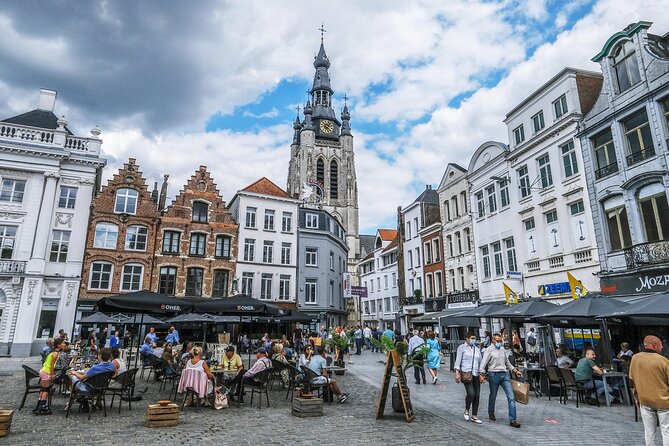
The trail brings you to Kortrijk’s Grote Markt with the belfry (Belfort). The belfry stands in the center and was part of the former cloth hall. The earliest mention of the cloth hall dates back to 1248.
This is a smart inclusion because it ties together civic identity and economic power. Cloth halls were where the money, production, and trading lived, and belfries often symbolized that civic confidence. Even if you don’t climb anything, standing here gives the city a clear center.
If your group tends to split attention, this is also a good meeting point. It’s central and recognizable, so navigation is easier when you need it.
Astrid Park, Groeningepoort, and the Golden Spurs memorial set
The route includes memorial and commemoration points tied to the Battle of the Golden Spurs. Expect to see references to Groeningepoort and also the Groeninge Gate and Groeninge monument, all built in connection with the 600th anniversary.
There’s also an Astrid Park note. The park was named after a visit by Queen Astrid to Kortrijk on 5 April 1935. That’s the kind of small story that makes a park feel less like blank green space and more like a place with ties to the people who shaped the city’s modern identity.
These are good stops if you like walking through cities with a sense of time. You’re moving from medieval beginnings to 19th-century and 20th-century references without it feeling like a random checklist.
Hospital courtyard: hospitality, not illness
One stop focuses on the hospital inner courtyard, described as one of the best preserved 17th century sites in Kortrijk. The important detail is the word meaning: “hospital” refers to hospitality, not illness.
That small clarification changes how you experience the space. Instead of picturing medical care, you picture welcome, lodging, and community support. It’s also a useful mental reset after memorials, because courtyards naturally encourage slower walking and quiet observation.
Kortrijk Theatre and the style of performing life
Another highlight is the Kortrijk Theatre, described as one of the largest performing arts centers in South-West Flanders. The building dates from 1920 and is conceived as a théâtre à l’italienne.
This is more than a pretty exterior stop. It connects the city to cultural life and design traditions from the theater world. If you’re the kind of traveler who likes architecture that wasn’t built for worship or defense, this fits that taste well.
It’s also a good checkpoint if you want a change of mood in the middle of the hunt.
Artillery Tower and the Franco-Flemish war context
Near the end of your walk, the trail points out the Artillery Tower, also called the Armorie Tower. It was built together with the castle in 1301 to 1302 by French King Philip the Fair, as part of the Franco-Flemish war against the Count of Vlaandere.
This stop adds a layer of geopolitics. You start to see that Kortrijk’s story wasn’t just local. It was caught in larger power struggles, and the built environment reflects that.
If you like your history practical, you’ll appreciate this framing, because it tells you why a structure exists.
Stopping for worship and popular devotion at the Passionists church
The last listed church stop is the church of the Passionists (1874), described as the archetypal church of popular devotion.
This is a good final segment if your group likes variety. You move from medieval and civic symbols into a more modern religious expression, and the tone shifts in a way that feels natural after the war and memorial stops.
Timing and pacing: getting the 2 to 4 hours to feel like your day
The duration is listed as about 2 to 4 hours. In my experience, that range works best if you treat it as a flexible framework rather than a deadline.
Here’s how to make it smooth:
- Give yourself at least one longer stop around the Beguinage or Groeninge Abbey / Kortrijk 1302 zone.
- Use the rose garden or courtyard stops as resets.
- If your phone gets low on battery, slow down and pause the route. Finish the stops you can reach comfortably.
Because the activity is private for your group, you can play by consensus. That’s also helpful if some people want photos and others want answers fast.
Value for the price: $37.33 per group up to 6
At $37.33 per group for up to 6 people, the math favors families and small groups more than solo travelers. Even if you’re paying for just two people, you’re still not dealing with per-person pricing, which keeps this activity from feeling like a costly add-on.
What you get for that price is a structured route plus an interactive app experience. You’re essentially buying time-saving planning and a reason to walk between spots you might otherwise skip. If you’re in Kortrijk for a short visit, that matters. If you’re there for longer, it still helps because it turns your free time into a guided loop you control.
For me, this is the kind of activity that can replace one “maybe we’ll wander” day. It gives your wandering a point, without shutting down spontaneity.
Who this e-Scavenger Hunt suits best (and who might not love it)
This fits best if you want:
- A self-guided walk where you can take breaks.
- A playful way to learn facts about landmark stories like the Beguinage and the Battle of the Golden Spurs.
- Something group-friendly that keeps everyone moving and talking.
It might feel less ideal if:
- You hate using your phone for wayfinding and answering prompts.
- Your group dislikes puzzles or competitive-style question formats.
- Your device has poor GPS or you don’t plan to have data available.
If you do bring data and keep your battery topped up, you’ll likely find the experience does exactly what it promises: a fun way to explore Kortrijk while picking up facts along the way.
Should you book the Qula Kortrijk city trail?
I’d book this if you’re the kind of traveler who likes cities with a mix of big landmarks and quieter corners, and you enjoy learning while you walk. It’s also a solid choice for mixed-age groups because the format includes questions designed to work for kids, while still covering serious history topics.
Skip it only if your phone experience is usually unreliable, or if you know you’ll be uncomfortable relying on data and a map for navigation. If you’re comfortable with that, you’ll probably like how Kortrijk comes alive through a route built around stories, not just sights.
FAQ
Do I need to bring a smartphone?
Yes. The experience includes an online app, but smartphone and data are not included, so you’ll need your own phone to play.
Is the tour self-guided or do I meet a guide?
It’s self-guided using the app. You play the game on your phone as you move between locations.
How long does the Kortrijk hunt take?
It takes about 2 to 4 hours.
What language is the experience offered in?
The activity is offered in English.
What group size can join?
It’s booked per group of up to 6 people.
Where do I start?
You start at Stationsplein 6, 8500 Kortrijk, Belgium.
Is it private for my group?
Yes. It’s private, so only your group participates.
Are service animals allowed?
Yes. Service animals are allowed.
Can I cancel and get a full refund?
Yes. You can cancel up to 24 hours in advance for a full refund.
What if my trip needs hearing accessibility support?
The experience is listed as user-friendly for hearing impaired.
Reviewed lately in Ghent
- Ghent Running and Sightseeing Tour★ 5.0 · 3 reviews
- Children’s escape game in the city of Ghent Marsupilami★ 5.0 · 3 reviews
- Ghent Walking Tour – City Highlights and Beyond Tradition★ 4.5 · 3 reviews
- Ghent Scavenger Hunt and Highlights Self Guided Audio Tour★ 3.5 · 3 reviews
- Discover Ghent while playing! Escape game – The alchemist★ 4.0 · 4 reviews
- e-Scavenger hunt Mons: Explore the city at your own pace★ 5.0 · 4 reviews
- Discover Ghent while playing! Escape game – The Walter case★ 4.5 · 4 reviews
- Discover Mons while playing! Escape game – The alchemist★ 4.0 · 5 reviews
Scavenger Hunts, compared.

e-Scavenger hunt Antwerp: Explore the city at your own pace
Read our review →
e-Scavenger hunt Bruges: Explore the city at your own pace
Read our review →
Bruges Scavenger Hunt and Highlights Self Guided Audio Tour
Read our review →
e-Scavenger hunt Ghent: Explore the city at your own pace
Read our review →
Beer Tasting and Scavenger Hunt in Brussels – About 3 Hours
Read our review →
e-Scavenger hunt Mechelen: Explore the city at your own pace
Read our review →
e-Scavenger hunt Hasselt: Explore the city at your own pace
Read our review →
e-Scavenger hunt Brussels: Explore the city at your own pace
Read our review →Browse the lists this tour appears in