
This full-day run through the Ypres Salient hits in a way that feels more human than most battlefield days. You get preserved trenches and museum stops, then you slow down at major cemeteries where the names are the point.
I especially love the small-group pace and the chance to get exact, place-by-place context from a guide who really knows the area. One thing to consider: two of the biggest museum stops have admissions that are not included, so you will want to budget for those.
Key highlights worth putting on your radar
- A guide who connects the dots on the ground using precise, grounded details at each stop
- Sanctuary Wood trenches, plus real battlefield photography and artifacts you can see up close
- Tyne Cot Cemetery and the Memorial wall for both the known graves and the missing
- St Julien Canadian Memorial and the 1915 gas attacks story tied to the Ypres Salient
- Hill 60 and the Caterpillar Mine Crater for the war underground, not just on the surface
- Max group size of 8 people, so questions do not get lost
A Ypres Salient day that feels structured, not rushed
This tour works because it has a clear rhythm: trenches and museums for understanding, cemeteries and memorials for reflection. You start with a preserved trench system, then you move outward to major sites tied to specific parts of the battle story.
What makes it stick is how the guide can keep the geography straight and then add the right layer of meaning. In a review, the guide was Roger, a published writer about the battlefield, and that kind of background shows in how each stop gets its own clear explanation.
With a max group size of 8 people, you are not fighting for attention. You also get some real flexibility about time on-site, which matters at places where you might want an extra minute to just look.
More Museums in Ypres:
- Brussels: Atomium Entry Ticket with Design Museum Ticket
★ 4.4 · 9,254 reviews - Choco-Story Brussels: Chocolate Museum Entrance with Tasting
★ 4.3 · 4,883 reviews - Bruges: Choco-Story Museum with Audio Guide and Tastings
★ 4.2 · 1,825 reviews
Pickup, timing, and how to plan your day
The tour starts at 10:00 am, with the meeting point at Station Ieper, Colaertplein 35, 8900 Ieper. Pickup is offered either from your accommodation in Ypres or from the car park at Ypres Rail station at 9:45 am, so you can decide what’s easiest for you.
The whole experience runs about 7 hours. That is long enough to hit the big highlights, but it is still tight, so treat it like a full-day commitment and not a slow afternoon stroll.
You’ll also get a mobile ticket, and the tour is offered in English. The pace should suit many people, but it is still a day of walking through preserved ground and museum spaces.
Stop 1: Sanctuary Wood Museum, trenches, and 3D battlefield photography
Sanctuary Wood Museum is where the day gains structure fast. You can see a large collection of rare 3D original battlefield photographs, plus an impressive set of Great War artifacts, weapons, and uniforms.
Then you move from images to place. The museum includes an extensive preserved British trench system that you can walk through, which is one of the best ways to make sense of what you see later.
A practical note: the museum is closed on Mondays. If your tour day falls then, you will visit alternative trenches instead. That swap is built into the experience, so the tour still keeps the trench focus.
Admission for Sanctuary Wood Museum is not included. If you want to control your total budget, this is one of the costs to plan for ahead of time.
Stop 2: Tyne Cot Cemetery, 12,000 graves, and a memorial wall for the missing
After driving through Passchendaele battlefields, you arrive at Tyne Cot Cemetery, one of the most moving stops in the area. It holds 12,000 graves and is the largest British and Commonwealth war grave cemetery in the world.
At the rear, you see the Tyne Cot Memorial wall with the names of a further 35,000 British and Commonwealth soldiers listed as missing, with no identified grave. That structure is powerful: it forces you to confront both what can be marked and what cannot.
This stop is free and short, about 35 minutes, which is just enough time to look slowly without feeling rushed. If you need a moment to process, you will get it here, because this is the kind of place where silence is the default.
A few more Ypres options to weigh up
- Full Day Canadian WW1 Vimy and Somme Battlefield Tour from Ypres
★ 5.0 · 6 reviews - From Brussels: Full-Day Antwerp and Ghent Guided Tour
★ 4.6 · 1,019 reviews - From Brussels: Bruges Full-Day Trip by Train
★ 4.5 · 232 reviews - From Brussels: Bruges and Ghent Full-Day Trip by Train
★ 4.3 · 103 reviews
Stop 3: St Julien Canadian Memorial, The Brooding Soldier, and 1915 gas attacks
Next comes the iconic St Julien Canadian Memorial, The Brooding Soldier, set in a memorial garden. This monument is dedicated to Canadian soldiers lost in the gas attacks of 1915.
This is a key stop because it shifts the story from mud and trenches to chemical warfare in the Ypres Salient. You learn the history of those attacks and what they meant for soldiers at the time.
The admission here is free, and the stop is about 20 minutes. That short timeframe can work well if you want the essential story, not a long museum-style lecture.
If you care about how warfare changed in that period, do not skip this one. The memorial makes the topic concrete instead of abstract.
Stop 4: Langemark Cemetery, the German cemetery atmosphere, and the mass grave center
Langemark Cemetery is a different kind of experience. It is the second largest German cemetery in the area, with 44,000 burials, and the atmosphere feels unlike the British and Commonwealth sites.
The design was heavily influenced by the Nazis of World War Two, and some of that influence is still visible today. You also see a mass grave in the centre, and the scale is described as mind-blowing.
This is another free stop, about 25 minutes. It is short, but it can hit hard because the place is built around collective loss rather than individual markers.
If you want more context before you go, consider finding a copy of Studentenfriedhof to Soldatenfriedhof, written in English. It’s recommended as a helpful way to understand the cemetery’s history before your visit, so you can follow what you are seeing.
Stop 5: Essex Farm Cemetery, the dressing station bunkers, and John McCrae
Essex Farm Cemetery focuses on the human logistics of war, not just the final resting places. You visit preserved dressing station bunkers to understand the wounded evacuation process.
You also see the memorial to Lt Col John McCrae, tied to the story of the In Flanders Fields poem and how it influenced remembrance today. That connection gives the site extra meaning because it links a specific person, a specific text, and a long-lasting cultural memory.
There is also a grave for Valentine Strudwick, killed at age 15. You will learn the story of underage soldiers in the Great War, which adds a grim, personal edge to the larger cemetery theme.
This stop is free and lasts about 30 minutes. It’s one of those places where you may want to spend a bit longer, but the tour keeps things moving so you reach the bigger museums later.
Stop 6: Passchendaele Museum, replica trenches, underground dugouts, and the updated experience
Passchendaele Museum is a major anchor of the day. This is described as world-class and it takes on the Battle of Passchendaele with replica British and German trenches that help you visualize how the front line worked.
You also get an underground replica dugout experience. That matters because it adds a different perspective on what soldiers faced, not just what was visible from above.
The museum also includes a new Battle of Passchendaele room and is being updated ready for 2025. Even if your visit is before those changes, the tour framing is clearly designed to make the battlefield understandable through multiple formats.
Plan on about 1 hour 30 minutes here. Admission is not included, so budget for it, especially if museum time is your priority.
Stop 7: Hill 60, the Murder Hill, and the war underground
After the Passchendaele Museum, the tour shifts back outdoors with Hill 60. British soldiers reportedly named it Murder Hill, and walking over the hallowed preserved battlefield gives you a direct sense of the ground where fighting happened.
You see preserved bunkers and mine craters. Hill 60 is today an official war grave, with the remains of many soldiers and tunnellers concealed beneath the surface.
What the guide focuses on here is the layered nature of conflict: the terrible fighting at Hill 60, the compact battlefield space where men could be separated by only a few meters, and the underground war. You also hear the story of Hill 60 in WW2, when fighting returned to the area.
This stop is free and lasts about 35 minutes. Because it involves preserved battlefield features, it helps to wear shoes with good grip, since you are on real ground, not smooth museum flooring.
Stop 8: Caterpillar Mine Crater, Hill 60 B, and the June 7, 1917 underground mines
The final storytelling stop is the Caterpillar Mine Crater, also known as Hill 60 B. Here, you get the story of the battle of Messines Ridge and how the war underground unfolded at this site.
On June 7, 1917, 19 massive underground mines were blown by British and Commonwealth tunnellers. The Caterpillar Crater is described as the best preserved of those mines.
The contrast is what people remember: it is breathtaking in scale and beauty, especially when you hold it next to what took place there. This stop is free and lasts about 30 minutes, giving you time to look at the crater form and still carry the earlier stories with you.
What you get for the $288.99 price, and what costs extra
At $288.99 per person, this is not the cheapest way to see the Ypres Salient. The value comes from three things working together.
First, you get transportation and a full route through major sites in about 7 hours, including pickup options from your accommodation or near the rail station. Second, you get a guide who, in at least one standout experience, was Roger, a published writer about the battlefield, and the difference shows in the precision and the ability to share details you might not have found on your own. Third, many stops are free, including Tyne Cot Cemetery, the Canadian memorial, Langemark, Essex Farm, Hill 60, and the Caterpillar Crater.
The two notable extras are admissions for Sanctuary Wood Museum and Passchendaele Museum. If you are comfortable paying for museum entry, you will likely feel the price is fair for a guided day that does more than tick boxes.
If you only want to see cemeteries and memorials, you might question the spend. If you want trenches, museums, and underground battlefield storytelling in one day, this is the kind of structure that justifies the cost.
Who this tour suits best, and who might want a different plan
This tour is a strong fit if you want a guided day with clear context at each stop. It also suits people who like to understand how the battlefield worked through trenches, artifacts, and underground features.
It is especially good for history-focused visitors who appreciate exact details, not just general impressions. The guide’s flexibility is also a plus, since it gives you control over how long you stay at a place that hits you personally.
If you prefer total DIY freedom or you want to spend half-days in one site, you might feel the schedule is packed. But if your goal is one well-planned day across the Ypres Salient’s biggest highlights, this route does that job cleanly.
Should you book this Ypres and Passchendaele full-day tour?
If you have one day in Ypres and you want the trench-and-memorial story told in a logical order, I think you should book it. The small group size, the guide’s high level of detail, and the mix of preserved trenches, major cemeteries, and underground sites make it feel like more than a bus tour.
I would only hesitate if you strongly dislike museum time or you do not want to pay extra admissions for Sanctuary Wood Museum and Passchendaele Museum. If that is you, you could choose a route focused only on the free outdoor memorials and cemeteries. Otherwise, this is a well-structured, meaningful day that respects both the ground and the names.
FAQ
What time does the tour start?
The tour starts at 10:00 am.
Where do I meet the group?
The meeting point is Station Ieper, Colaertplein 35, 8900 Ieper, Belgium.
Is pickup available?
Yes. Pickup is offered either from your accommodation in Ypres or from the car park at Ypres Rail station at 9:45 am.
How long is the tour?
The duration is about 7 hours.
What languages is the tour offered in?
The tour is offered in English.
How big is the group?
The maximum group size is 8 people.
Do I need tickets for every stop?
No. Admission tickets are not included for Sanctuary Wood Museum and Passchendaele Museum. Admission for Tyne Cot Cemetery, the Canadian memorial, Langemark Cemetery, Essex Farm Cemetery, Hill 60, and the Caterpillar Mine Crater is free.
Is the Sanctuary Wood Museum visit affected by the day of the week?
Yes. Sanctuary Wood Museum is closed on Mondays, and the tour visits alternative trenches instead.
How far in advance is this tour usually booked?
On average, it is booked 106 days in advance.
What is the cancellation policy?
You can cancel for free up to 24 hours in advance of the experience for a full refund. If you cancel less than 24 hours before the start time, the amount you paid is not refunded.
Reviewed lately in Ypres
- Bellewaerde Aquapark Entrance Ticket★ 4.4 · 19 reviews
- Ypres: An exploration of the deadly salient battlefields★ 5.0 · 76 reviews
- In Flanders Fields and Passchendaele Half Day Morning Tour★ 5.0 · 117 reviews
- From IEPER Private 4-hour Tour of the Ypres Battlefield★ 5.0 · 154 reviews
- From Ypres: WWI Battlefields Private Tour★ 5.0 · 25 reviews
- From LIlle or Bruges, Christmas Truce to Passchendaele Ypres 1 day WW1 private★ 5.0 · 5 reviews
- From Ypres, The Christmas Truce to Passchendaele Ypres Based WW1 private tour★ 5.0 · 29 reviews
- Full Day Canadian WW1 Vimy and Somme Battlefield Tour from Ypres★ 5.0 · 6 reviews
Flanders Fields & WWI Battlefields, compared.
From Bruges: Great War Flanders Fields Minibus Tour w/ Lunch
Read our review →
Flanders Fields Remembrance Tour from Brussels
Read our review →
From IEPER Private 4-hour Tour of the Ypres Battlefield
Read our review →
In Flanders Fields and Passchendaele Half Day Morning Tour
Read our review →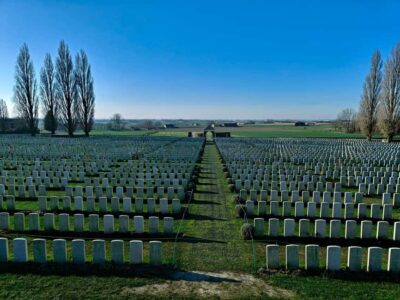
Ypres: An exploration of the deadly salient battlefields
Read our review →
From Bruges: Flanders Fields Remembrance Full-Day Trip
Read our review →
Small Group Ypres Remembrance Day Filled With War History
Read our review →Browse the lists this tour appears in